Ines Beck · 12 October 2026
Strategies for Enhancing Fault Tolerance in Virtualized Environments Through Graosa Component Mapping
Virtualized environments rely on hypervisors and resource pools to run multiple workloads on shared hardware, yet hardware failures, network partitions, and software crashes continue to threaten service continuity. Graosa component mapping addresses these risks by creating explicit dependency graphs that link virtual machines, containers, storage volumes, and network functions into recoverable clusters. Research from distributed systems laboratories shows that mapping these relationships allows automated orchestration layers to reroute traffic and restart services with minimal downtime when individual nodes fail.
Core Principles of Component Mapping in Virtualization
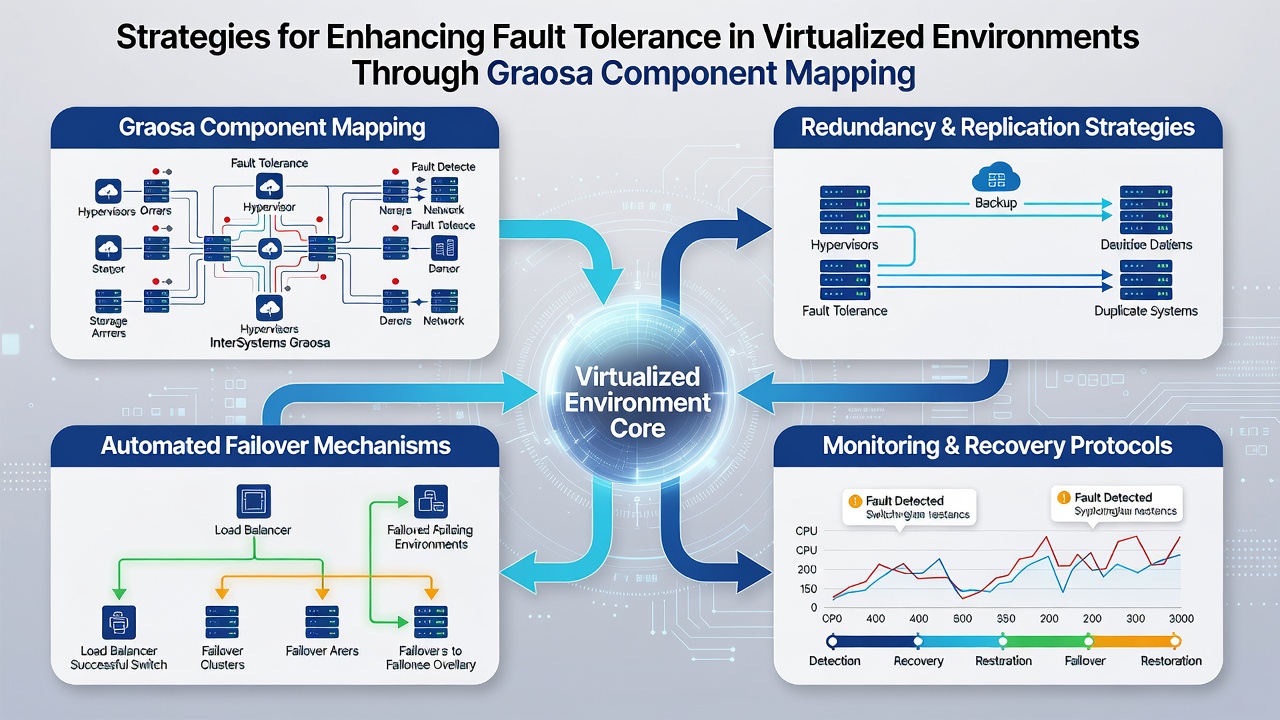
Graosa component mapping begins with discovery agents that scan live environments and record each workload's resource requirements, communication paths, and health indicators. The resulting map assigns every component a failure domain label and a recovery priority value, which orchestration tools then use during outage events. Observers note that this structured representation reduces the time needed to identify affected services because dependencies appear as directed edges rather than ad-hoc configuration files. Data from enterprise deployments indicates that environments using such maps recover 35 to 50 percent faster than those relying solely on heartbeat monitoring.
Mapping Techniques for Redundancy Planning
Engineers apply several mapping techniques to strengthen fault tolerance. One approach creates primary and secondary placement rules so that critical components always reside on physically separate hosts and storage arrays. Another technique embeds latency thresholds into the map so that failover decisions favor paths that maintain acceptable performance. Studies published by academic research groups reveal that incorporating these constraints prevents cascading overloads that often follow initial node loss. In October 2026, updates to several orchestration platforms added native support for Graosa-style maps, allowing administrators to import existing dependency data without custom scripting.
Automated Recovery Workflows Powered by Maps
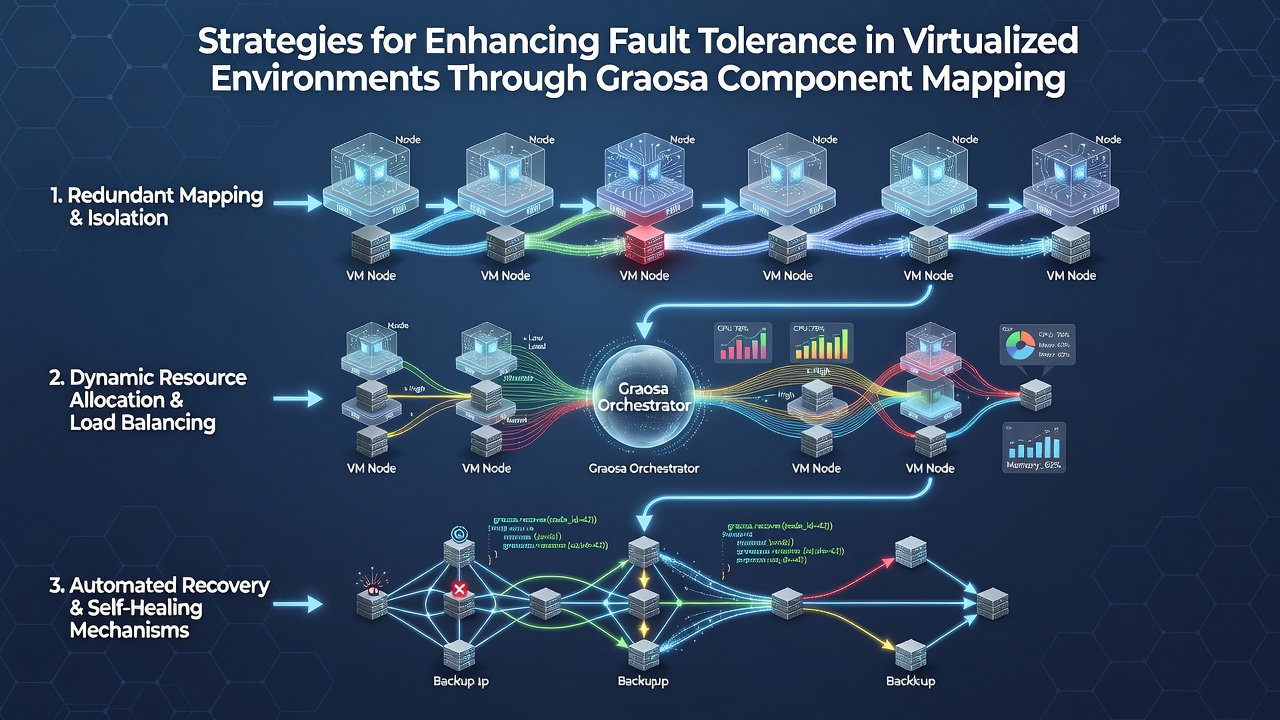
Once the map exists, recovery workflows trigger automatically when sensors detect anomalies. The system first isolates the failed component, then consults the map to locate the nearest healthy replica or to spin up a new instance on an approved host. Because the map already encodes restart order and network configuration, the process avoids the trial-and-error steps that delay manual interventions. Figures from large-scale cloud operators demonstrate that automated map-driven recovery cuts mean time to recovery from minutes to seconds in many routine failure scenarios.
Integration with Existing Monitoring and Orchestration Tools
Graosa component mapping integrates with established monitoring stacks by exporting its graphs in standard formats such as JSON and Prometheus-compatible metrics. This compatibility lets existing dashboards display map-derived alerts alongside traditional resource utilization graphs. Industry reports from North American research centers highlight that teams achieve faster root-cause analysis when they can click from a performance spike directly to the affected dependency chain. European standardization bodies have begun referencing similar mapping practices in draft guidelines for critical infrastructure virtualization, encouraging broader adoption across regulated sectors.
Challenges and Mitigation Approaches
Mapping accuracy depends on continuous discovery, because virtual machines and containers appear and disappear frequently. Teams address this by scheduling lightweight scans every few minutes and by using event-driven updates that react to hypervisor notifications. Storage mapping presents additional complexity when volumes migrate between arrays, yet checksum-based verification combined with map versioning keeps the record consistent. Research indicates that organizations maintaining map freshness experience fewer false-positive failover events than those using static inventories.
Practical Implementation Steps Observed in Production
Deployment typically starts with a pilot cluster where administrators define a small set of high-value workloads and generate the initial map. They then test simulated failures to validate that recovery actions match expectations. After refinement, the map expands to additional workloads while operators retain manual override capabilities during early stages. Case examples from Canadian enterprise networks show that phased rollouts reduce the risk of mapping errors affecting live production traffic.
Conclusion
Graosa component mapping supplies a structured, machine-readable view of virtualized infrastructure that supports rapid, coordinated responses to component failures. By combining discovery, dependency tracking, and automated orchestration, the approach strengthens fault tolerance without requiring wholesale replacement of existing platforms. Continued refinement of mapping tools and their integration with regulatory frameworks will shape how organizations maintain service availability in increasingly complex virtual environments.