
Ines Beck · 28 September 2026
Insights into Latency Reduction Strategies for Enterprise-Level Distributed Systems
Enterprise-level distributed systems handle vast amounts of data across multiple geographic locations, and latency remains a persistent challenge that affects overall performance and user experience. Researchers at various institutions have documented how delays in data transmission between nodes can compound quickly when thousands of requests occur simultaneously, leading organizations to explore targeted reduction methods that address both network and application layers.
One approach involves implementing advanced caching layers that store frequently accessed data closer to the point of use, which reduces the need for repeated queries to central databases. Data indicates that companies adopting multi-tiered caching structures often see measurable drops in response times, particularly in environments where read-heavy workloads dominate daily operations. Studies from academic sources have shown that combining in-memory caches with distributed object stores creates a buffer against peak traffic periods without requiring hardware overhauls.
Network Optimization Techniques
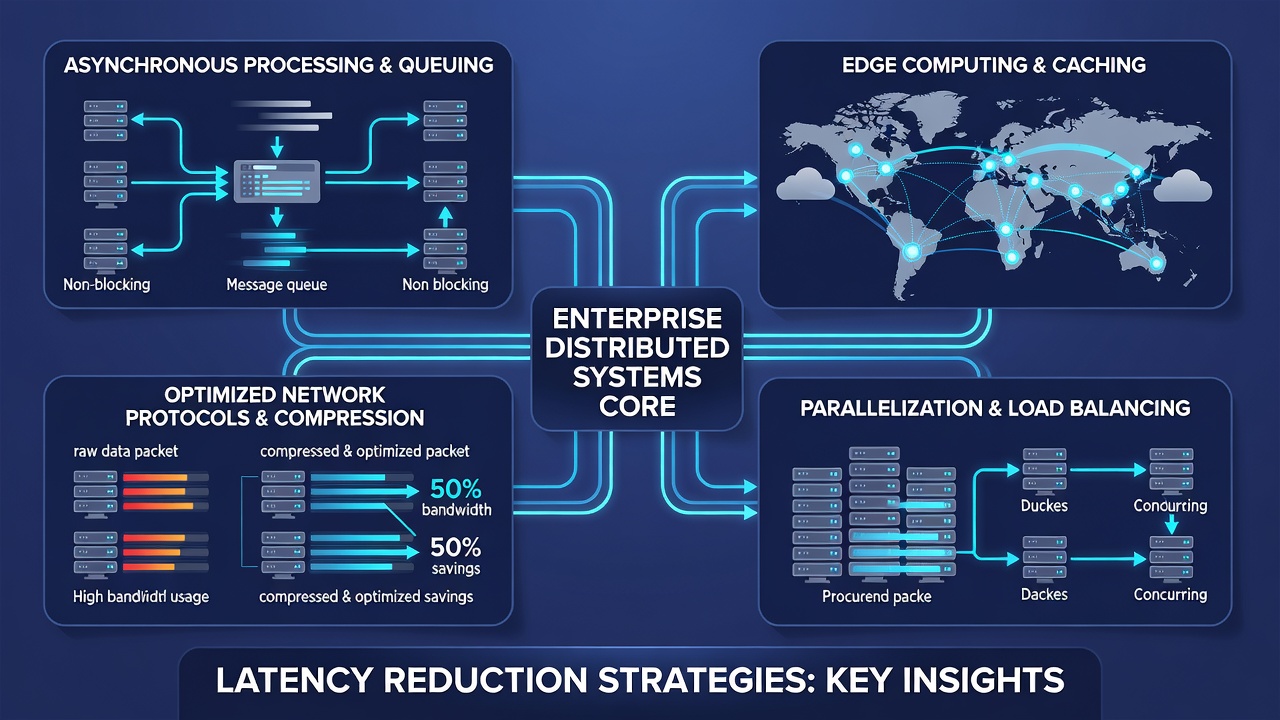
Network protocols play a central role in determining how quickly information travels between components, and updates to transport layer standards have provided new tools for minimizing delays. Organizations have begun deploying protocol enhancements such as QUIC alongside traditional TCP stacks, allowing parallel data streams that recover faster from packet loss. According to a report published by the National Institute of Standards and Technology, these protocol adjustments have demonstrated consistent improvements in high-volume transaction environments when properly configured across all nodes.
Load balancing algorithms have also evolved to incorporate real-time metrics rather than static round-robin methods, routing requests based on current node health and predicted congestion. This dynamic allocation helps prevent bottlenecks that form when certain servers become overwhelmed while others sit idle, and figures from industry monitoring tools reveal that such adaptive systems maintain steadier throughput during sudden demand spikes.
Data Locality and Edge Processing
Placing computational resources nearer to data sources reduces the physical distance that packets must travel, which directly impacts round-trip times in global setups. Edge computing deployments have expanded in recent years, with enterprises setting up regional processing hubs that handle filtering and aggregation tasks before forwarding summarized results to core facilities. Observers note that this model cuts down on unnecessary data movement across long-haul links, especially for applications involving sensor networks or real-time analytics.
Database sharding combined with geographic replication further supports locality goals by ensuring that queries resolve against the nearest available copy whenever possible. Research indicates that consistent hashing techniques minimize data reshuffling during node additions or failures, keeping latency spikes brief and localized rather than system-wide. In September 2026, several major cloud providers plan to release enhanced replication tools that automate shard placement based on traffic patterns observed over preceding months.
Monitoring, Prediction, and Asynchronous Patterns
Continuous monitoring platforms now integrate machine learning models that forecast latency trends before they escalate into noticeable slowdowns, giving operators time to adjust resource allocation proactively. These predictive systems analyze historical traffic alongside current metrics such as queue depths and CPU utilization, triggering scaling events automatically when thresholds approach. Evidence from deployments at large financial institutions shows that early intervention through such tools keeps average response times within acceptable bounds even as user volumes grow.
Asynchronous processing decouples time-sensitive operations from background tasks, allowing the main application thread to return results while secondary work completes later. Message queues and event-driven architectures facilitate this separation, and data from production environments reveals fewer timeout errors when heavy computations move off the critical path. Teams that adopt these patterns often combine them with circuit breaker patterns to prevent cascading failures across dependent services.
Conclusion
Latency reduction in enterprise distributed systems requires coordinated changes across infrastructure, software design, and operational practices. Organizations that combine caching, protocol improvements, edge resources, and predictive monitoring achieve more stable performance under varying loads, while ongoing research continues to refine these methods for increasingly complex environments. The strategies outlined here represent established practices backed by measurements from multiple sectors, providing a foundation for further optimization as systems scale.