Klara Long · 26 October 2026
Examining Throughput Optimization Techniques in Collaborative Sensor Array Deployments for Environmental Data Aggregation
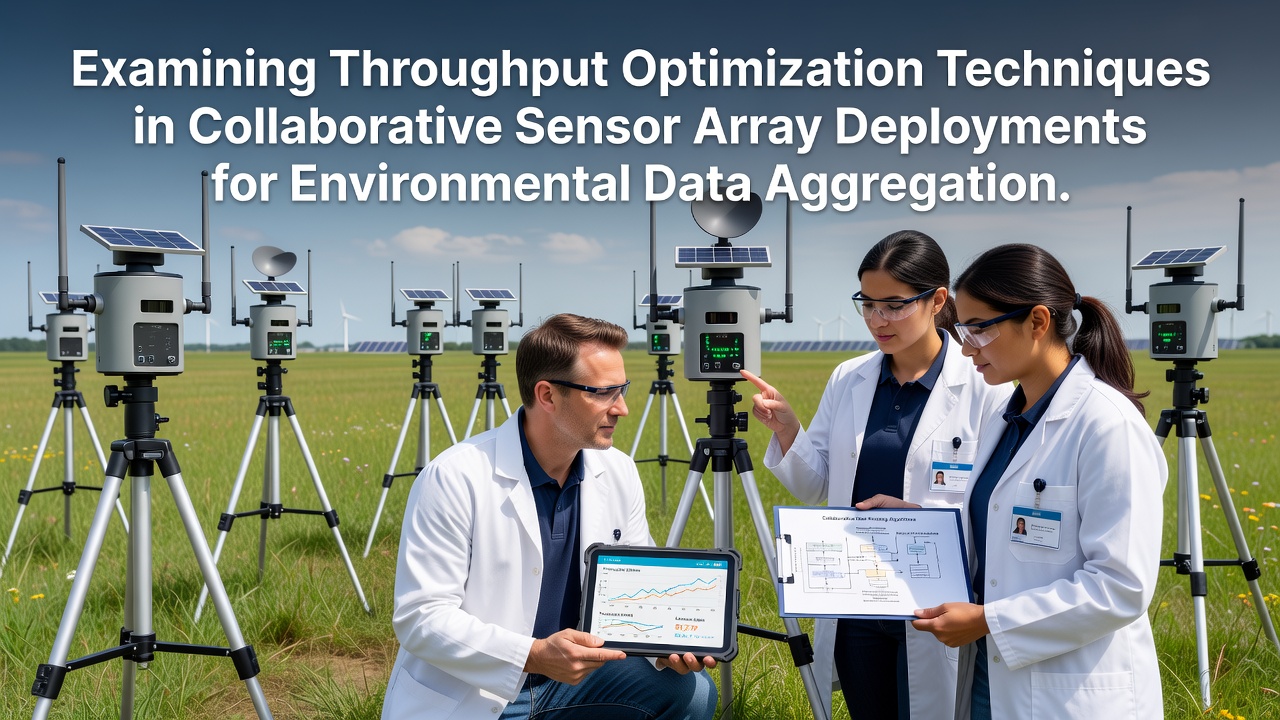
Collaborative sensor arrays gather environmental data across wide areas where individual nodes work together to collect temperature, humidity, soil moisture, and air quality readings, and throughput optimization becomes essential because raw transmissions from every device quickly overwhelm bandwidth limits and drain battery reserves. Researchers discovered that data aggregation at intermediate points reduces redundant packets while preserving accuracy, and this approach gained traction in large-scale deployments tracked through 2026 reports from agencies monitoring climate variables.
Core Challenges in Sensor Array Throughput
Nodes in these arrays face interference from dense deployments, variable channel conditions, and the sheer volume of continuous readings, yet collaborative protocols allow neighboring sensors to share processing tasks and forward aggregated summaries instead of every raw sample. Data shows that without such coordination, packet loss rates climb above 30 percent in moderate traffic scenarios, according to field tests conducted across multiple regions. Observers note that environmental factors like rain or foliage further degrade signal strength, which forces systems to adapt routing paths dynamically and prioritize high-value measurements during peak collection windows.
Key Optimization Techniques
Compressive sensing stands out as one method where sensors transmit fewer samples by exploiting signal sparsity, and reconstruction algorithms at the base station recover full datasets with minimal error margins. Studies indicate this technique cuts transmission volume by up to 70 percent in temperature monitoring networks, while maintaining statistical fidelity for trend analysis. Cluster-based aggregation organizes nodes into groups that elect heads to fuse readings locally before forwarding summaries, and this structure balances load across the array while shortening average hop distances to the sink.
Routing protocols such as directed diffusion or LEACH variants incorporate throughput-aware metrics that select paths based on remaining energy and current queue lengths, and researchers have observed lower latency in data delivery when these adaptive mechanisms replace static shortest-path approaches. Scheduling algorithms assign transmission slots to avoid collisions, and time-division multiple access combined with spatial reuse allows concurrent operation in non-overlapping zones. What's interesting is how hybrid methods merge compression with clustering to achieve cumulative gains, as one study revealed throughput increases of 2.5 times compared with baseline flooding strategies.

Deployment Patterns and Real-World Applications
Deployments in river basin monitoring use underwater acoustic arrays alongside terrestrial nodes, and optimization here requires accounting for propagation delays unique to water environments. European Environment Agency data from ongoing projects highlight how collaborative fusion at edge gateways supports real-time alerts for pollution spikes without saturating backhaul links. In October 2026, several North American initiatives expanded sensor grids across agricultural zones to track drought indicators, and reports from the Environmental Protection Agency noted successful integration of optimization layers that sustained collection rates above 95 percent even during high-wind events that typically disrupt wireless links.
Australian research institutions tested similar arrays in arid zones where water scarcity data drives policy, and findings showed that load-balancing across multiple sinks prevented bottlenecks during seasonal rainfall bursts. People who've examined these systems often discover that machine learning models trained on historical traffic patterns predict congestion windows and trigger preemptive aggregation adjustments. Such predictive elements integrate with existing protocols to maintain steady throughput without manual intervention.
Performance Metrics and Evaluation Approaches
Throughput gets measured in bits per second delivered to the aggregation point alongside metrics for energy per bit and end-to-end delay, and comparative trials across testbeds reveal that combined compressive and clustering methods outperform single-technique baselines under identical conditions. Figures from collaborative trials indicate packet delivery ratios above 92 percent when adaptive scheduling accounts for both temporal and spatial interference patterns. Those who've studied this know that simulation tools like NS-3 or OMNeT++ allow rapid prototyping of new variants before hardware validation, and cross-validation against field data strengthens confidence in projected gains.
Security considerations enter the picture because encrypted payloads add overhead, yet lightweight schemes tailored for sensor constraints preserve most throughput benefits. Observers note that geographic diversity in testing locations, from Canadian boreal forests to Mediterranean coastal zones, helps identify technique robustness across climates and deployment densities.
Conclusion
Throughput optimization in collaborative sensor arrays for environmental data aggregation relies on layered techniques that compress, cluster, schedule, and route information efficiently, and ongoing deployments through 2026 demonstrate measurable improvements in delivery rates and resource use. Research indicates continued refinement through hybrid algorithms will support expanding networks tasked with finer-grained climate and ecosystem tracking. Data from varied global sources confirms these methods scale effectively when adapted to local conditions and hardware constraints.